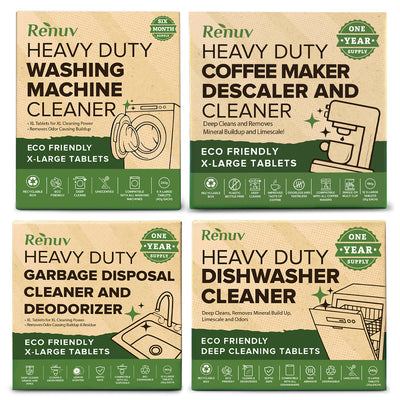
Nobody plans to clean an appliance. You notice the washer smells on a Sunday night, or the dishwasher leaves film on the glasses right before people come over, and that's the moment you want the right cleaner already sitting in the cabinet. Ordering one and waiting two days means living with the smell for two days, and usually means the job doesn't happen at all.
So it's worth treating appliance cleaners like pantry staples: a small set you keep stocked and replace before they run out. Here's what belongs in that set and why each one is there.
Why one cleaner can't do it all
The four machines that need regular cleaning each have a different problem. A washer builds up detergent film and body-soil residue in the drum and gasket. A dishwasher collects food debris, grease, and hard-water minerals. A garbage disposal holds decaying food residue on its grinding parts and splash guard. A coffee maker scales up with dissolved minerals baked onto a heating element.
Those are different kinds of buildup on different materials, which is why each cleaner is formulated for its machine. The all-purpose spray under your sink handles none of them, because the buildup that matters is inside the machines where a spray can't go.

The core four
Washing machine cleaner. Runs in an empty hot cycle and circulates through the drum, the outer tub, and the drain path, breaking down the detergent film and residue that cause musty laundry smell. If you only stock one cleaner, this is the one, because washer odor is the buildup problem people notice first. Our guide on removing washing machine odor covers the full routine.
Dishwasher cleaner and deodorizer. Handles grease, food residue, and the hard-water film that shows up as cloudy glassware. It reaches the parts of the machine the spray arms feed but a sponge never touches. Pair it with a quick filter rinse and the machine stays fresh; the details are in how to remove dishwasher odors.
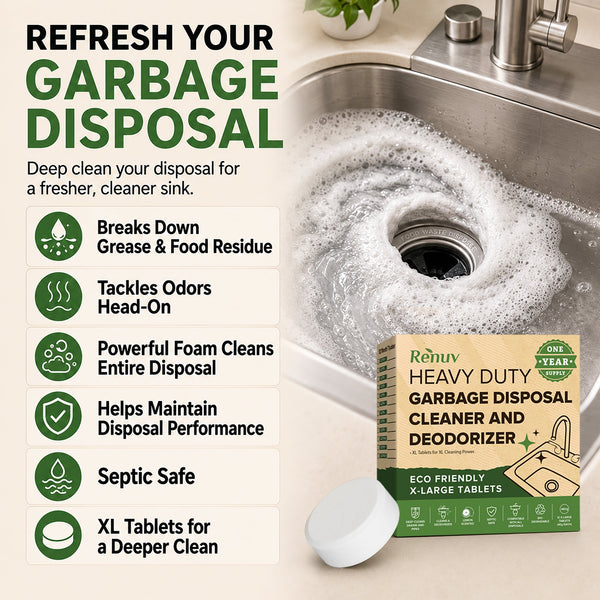
Garbage disposal cleaner. The disposal is the fastest machine in the house to develop a smell, because food residue sits in a warm wet chamber all day. A foaming disposal cleaner scrubs the grinding chamber and the underside of the splash guard, the spot most people never clean. More on that in why your garbage disposal smells.
Coffee maker cleaner and descaler. Dissolves the mineral scale that slows brewing and flattens the taste of the coffee. Tablets are easier to store and dose than liquid descalers, and they skip the vinegar smell entirely. If you're not sure your machine needs it yet, the signs are in coffee maker limescale: signs you need to descale.
What you can skip
You don't need a cabinet full of specialty products beyond these. Scented drum fresheners and in-wash boosters mask odor without removing the residue causing it. Bleach is tempting for a smelly washer, but it's hard on rubber gaskets over time and doesn't dissolve detergent film or mineral scale. And gadget-style gimmicks, disposal "freshener balls" and the like, mostly add perfume. The pattern is worth noticing: anything that promises freshness without an empty cleaning cycle is treating the symptom.
How much to keep on hand
The math is simple. Each machine wants a monthly cleaning, so a household running all four uses roughly 48 tablets a year, twelve per machine. Most packs cover several months, so a realistic rhythm is restocking two or three times a year. Keep everything together in one spot, ideally the laundry room shelf, and put a single repeating reminder on your calendar. One day a month, run all four machines. The whole routine, laid out step by step, is in the monthly appliance cleaning checklist.
When one product runs out, that empty slot on the shelf is the restock signal. It sounds trivial, but the households that keep appliances fresh are the ones that never have to order a cleaner after the smell shows up.
Frequently asked questions
Which appliance cleaners should I keep at home?
Four: washing machine cleaner, dishwasher cleaner and deodorizer, garbage disposal cleaner, and coffee maker cleaner and descaler. Each targets the specific buildup its machine creates.
Can I use one cleaner for every appliance?
Not effectively. Washer film, dishwasher grease, disposal residue, and coffee maker scale are different problems on different materials. Each machine's cleaner is formulated for its own buildup and delivery method.
How long does a supply of appliance cleaners last?
At one cleaning per machine per month, most multi-tablet packs last several months. Restocking two or three times a year keeps you covered.
Is a bundle worth it over buying separately?
If you're cleaning all four machines on the same monthly schedule, a bundle keeps the supply synced so nothing runs out mid-routine.
Related reading
- The monthly appliance cleaning checklist for a fresher home
- How to remove washing machine odor
- Dishwasher cleaner and deodorizer: how to remove odors
- Why your garbage disposal smells and how to fix it
Shop the Whole-Home Appliance Cleaner Bundle
Browse the full range: all Renuv appliance cleaners.