Limescale is sneaky. Your coffee maker can look spotless on the counter while the parts that matter, the heating element, the tubing, the brew path, slowly coat themselves in mineral buildup. The machine doesn't fail. It just gets a little slower, a little louder, and the coffee gets a little worse, so gradually that you adjust without noticing.
Here's how to tell when scale has moved in, and what to do about it before it costs you a machine.
What limescale is and where it hides
Tap water carries dissolved minerals, mostly calcium and magnesium. When water heats, some of those minerals come out of solution and stick to whatever surface is nearby. In a coffee maker, that means the heating element gets it worst, followed by the tubing that carries hot water, the valve areas, and the showerhead that sprays over the grounds.
The buildup is chalky and hard, and it grows in layers. A machine in a hard-water area can develop a noticeable coating in a month or two. And because almost all of it forms inside the water path, you can't see it by looking in the reservoir.

The signs you're due to descale
Your machine will tell you, if you know what to listen for:
- Brewing takes longer. Scale narrows the water path, so the same pot takes more time. If your morning pot used to finish before you got out of the shower and now it doesn't, that's scale.
- It's gotten louder. Gurgling, sputtering, knocking. Scale on the heating element makes water boil unevenly, and you hear it.
- The pot comes up short. You fill the reservoir to ten cups and get nine. Water is fighting to get through.
- The coffee tastes flat or slightly bitter. Scale changes brew temperature and drags a mineral edge into the cup. Fresh beans can't fix it.
- White or gray crust at the reservoir edges. If you can see it there, there's more of it where you can't see.
- Steam sputters from the spout. On single-serve machines this is often the first symptom, along with weak or split streams.
Two or more of these together is a clear signal. One on its own is worth acting on anyway, since descaling is cheap and buildup only goes one direction.
Why waiting costs you
A scaled heating element is insulated by the buildup, so the machine runs hotter and longer to hit brew temperature. That extra strain shows up as shortened machine life, and heavy scale is a common reason drip machines and pod machines die at year two instead of year six. It also never gets easier to remove. Light scale dissolves in one descaling cycle. A year of it can take several.
How to descale, step by step
- Empty the carafe and remove any filter or pod. The cycle runs with no coffee.
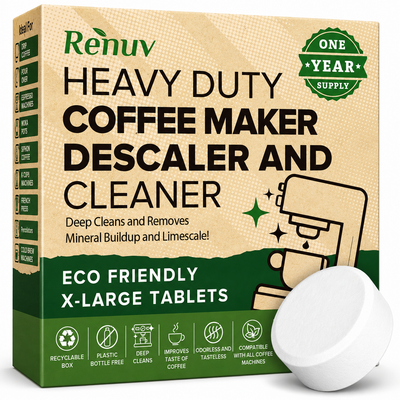
- Fill the reservoir with fresh water and drop in a descaling tablet. Give it a minute to dissolve.
- Run a full brew cycle. The solution travels the same route the water does, dissolving scale off the heating element, tubing, and brew path as it goes.
- Dump what lands in the carafe. Cloudy or flecked water is normal. That's the scale leaving.
- Rinse by running one or two more cycles with plain water. Don't skip this. It flushes loosened scale and any leftover solution so your next pot tastes like coffee.
If the machine was badly scaled, run a second descaling cycle before the rinse. If the reservoir itself has visible crust, our guide on cleaning a coffee maker water reservoir covers that part.
About vinegar
Vinegar can dissolve scale, but it's a blunt tool. The smell lingers for several brews, it's weaker on heavy buildup than a purpose-made descaler, and makers like Keurig warn against it because the acidity wears on seals and internal parts over time. We lay out the full comparison in coffee maker cleaner vs vinegar. Short version: a descaling tablet does the job without making your kitchen smell like a salad.
How often to descale
It depends on your water. Hard-water homes, which cover a large share of the country, should descale monthly. Soft-water homes can stretch to every two or three months. If you don't know your water hardness, the machine will tell you: the faster the signs above come back after a descale, the harder your water, and the tighter your schedule should be.
Daily brewers should lean toward the shorter end either way. A quick monthly cycle takes ten minutes and keeps you from ever meeting the heavy-buildup version of this job.
Frequently asked questions
How do I know if my coffee maker has limescale?
Slower brewing, louder operation, short pots, flat-tasting coffee, and white crust at the reservoir edges are the main signs. Most scale forms inside the water path where you can't see it, so go by symptoms, not looks.
How often should I descale my coffee maker?
Monthly in hard-water areas, every two to three months with soft water. If symptoms return quickly after a descale, shorten the interval.
Can limescale ruin a coffee maker?
Over time, yes. Scale insulates the heating element and forces the machine to work harder, which shortens its life. Heavy buildup can also clog the water path entirely.
Does descaling change the taste of coffee?
It restores it. Scale drags a mineral edge into the cup and throws off brew temperature. After a descale and a proper rinse, the same beans usually taste noticeably cleaner.
Related reading
- Why you need to clean and descale your coffee maker
- Coffee maker cleaner vs vinegar: which is better for buildup?
- Citric acid for cleaning coffee makers: when to use it
- Cleaning your coffee maker with vinegar is a bad idea
Shop Renuv Coffee Maker Cleaner & Descaler Tablets
Browse the full range: coffee maker cleaners and natural descalers.